
About the New Mexico Department of Public Safety
The New Mexico State Central Repository for Criminal History sits in the Law Enforcement Records Bureau, or LERB, within the DPS Technical Support Division. The repository operates under §29-3-11 NMSA 1978. It maintains fingerprint-supported New Mexico felony, DWI, and qualifying misdemeanor arrest cycles, then links outcomes received from courts and prosecutors.
LERB is more than a rap-sheet office. Its work includes the Automated Fingerprint Identification System, NCIC support, UCR and NIBRS reporting, the Sex Offender Registry Unit, the Expungement Unit, an IPRA unit, and the Criminal History Clearinghouse. These systems have different audiences and access rules. A record available to criminal justice is not automatically part of a public check.
The official LERB overview presents that statewide service portfolio.
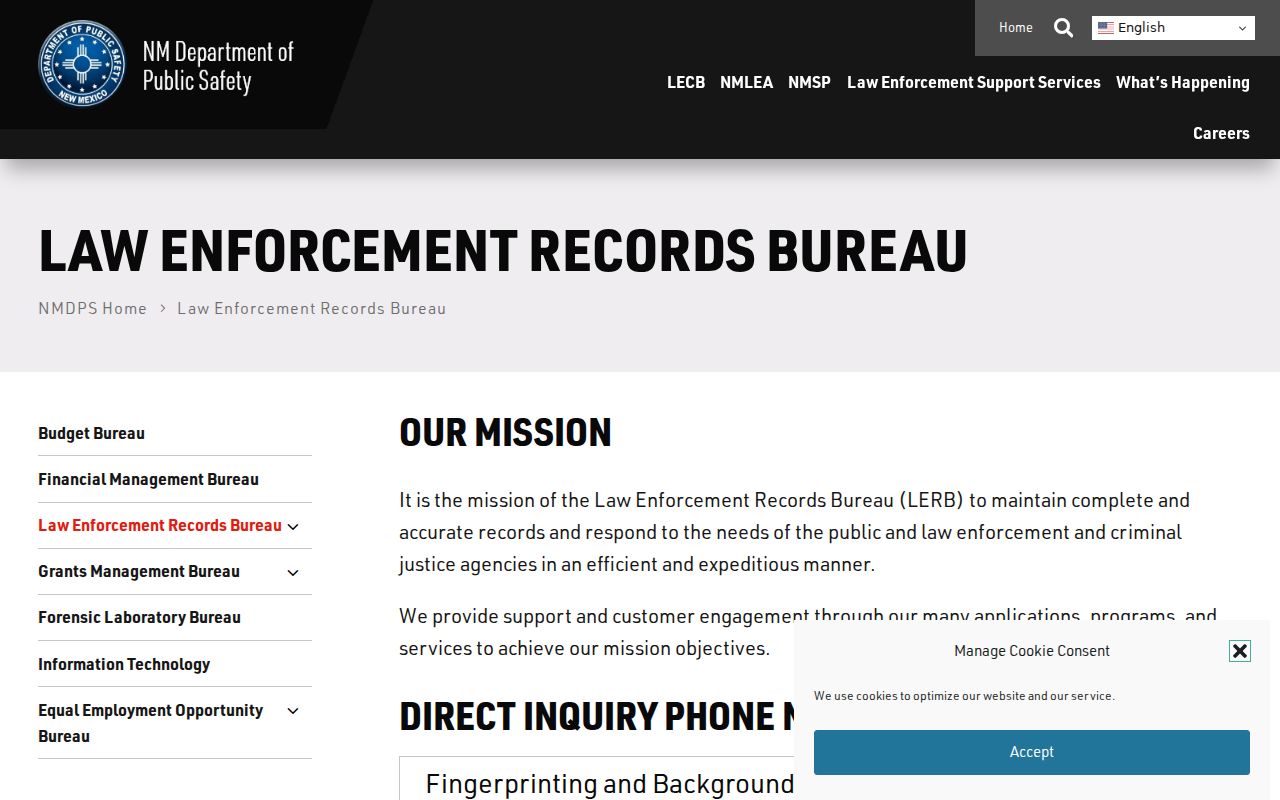
The bureau page is the stable starting point for current forms, services, contacts, and product terms.
New Mexico DPS Repository History
New Mexico's modern repository rests on the 1975 Arrest Record Information Act and fingerprint and disposition rules developed in 1978. DPS became a cabinet department in 1987. Federal profiles show the state file moving from no reported automation in 1993 to full automation in 1995. Electronic disposition duties strengthened in 2002, and statewide UCR began operating in 2008.
A 2019 rewrite placed immediate electronic biometrics, separate state arrest tracking numbers, persistent state identity numbers, and structured charge codes at the core of reporting. The Criminal Record Expungement Act took effect in 2020. NMAPS capture moved to IDEMIA and IdentoGO in 2023. Recent work includes an AFIS upgrade and digitization of about 400,000 older paper items under a $2.2242 million fiscal 2024 federal award.
Historical scale helps place that change in context. A 2018 federal profile estimated about 634,000 subjects in the New Mexico file and 383,626 state-supported Interstate Identification Index records. Those are dated measures, not a current inventory. They show why automation and precise identity matching became central to New Mexico DPS operations.
Note: Historical repository totals measure an earlier file and should not be read as the current number of New Mexico records.
Criminal History Checks Offered by New Mexico DPS
New Mexico DPS does not sell an unrestricted, instant, consent-free name search. Its main public criminal-history route uses an original notarized authorization. The subject, counsel, or an authorized agent can request the fingerprint-supported adult New Mexico arrest record. Separate products serve a police certificate, authorized NMAPS programs, fingerprint-card capture, and DPS records requests under IPRA.
| Product | Who may order | What it returns | Cost |
|---|---|---|---|
| DPS arrest record | Subject, counsel, or authorized agent with original notarized release | Covered adult fingerprint-supported New Mexico arrests and received outcomes | $15 |
| Police Certificate of Good Standing | Subject using the required authorization | Certified DPS product commonly used for immigration or visa needs | $33 |
| NMAPS state or federal check | Person using an authorizing program's service code | Program-scoped result delivered to the requesting agency | Service-code-specific |
| Manual fingerprint cards | Member of the public at DPS headquarters | Rolled cards, not a finished check | $9 first two; $2.50 each additional |
| Electronic DPS IPRA response | Any requester, subject to exemptions | Existing releasable DPS records, not the authorized rap sheet | Free |
The DPS fingerprinting and record-check page supplies current product instructions.
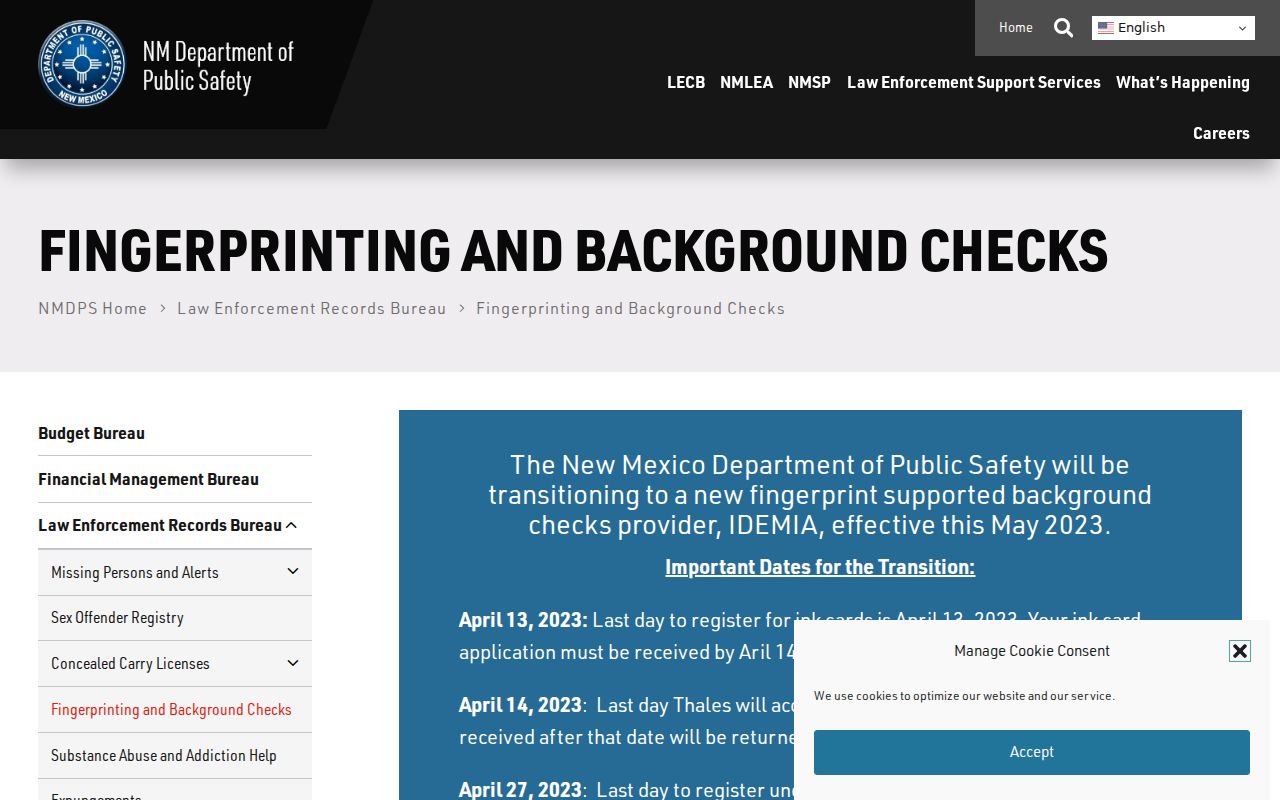
The product page separates a completed criminal history check from the narrower service of rolling fingerprint cards.
Review Your New Mexico DPS Record
The current Authorization for Release of Information form is a consent channel, not a public search. It asks for the subject name, Social Security number, date of birth, recipient name and address, original signature and date, and complete notarial details. The authorization can name the subject as recipient. DPS guidance says incomplete identity fields, missing notarization, illegibility, a missing destination, or improper payment can cause rejection.
Mail the original form with a $15 cashier's check or money order payable to NMDPS. The published turnaround is 7 to 15 working days. A scan does not replace the original-signature route. Keep a copy of the request, payment, tracking, and returned record because those items help if a later correction is needed.
No open rap-sheet portal: Someone else's public history must be checked through Case Lookup, the originating court and county records, and other official systems within their stated scope.
Note: Notarization confirms the signature on the authorization; it does not confirm that every item in the returned repository record is accurate.
How Records Flow Into the New Mexico DPS Repository
A qualifying New Mexico booking starts the repository chain. The booking facility takes biometrics before release, assigns a separate state arrest tracking number, associates the event with the person's state ID, enters charge codes, and submits the transaction electronically. DPS forwards biometrics to the FBI and provides arrest information to prosecutors. Courts and criminal-justice agencies later report the outcome.
Data flow: County Booking › Fingerprint Submission › New Mexico DPS › County Disposition Reporting › Rap Sheet
The arresting agency owns its report. The detention body owns booking data. The court clerk owns filed pleadings and certified outcomes. New Mexico DPS owns the compiled identity-centered repository record. Those connected records can update on different schedules, so the freshest dismissal may appear in Case Lookup before it reaches the rap sheet.
Why New Mexico DPS Records Lag
Repository accuracy depends on every contributor. A December 2025 Legislative Finance Committee analysis found final dispositions attached to only 7% of New Mexico arrests made in the prior five years. That was the lowest reported state rate in the analysis. A blank outcome does not show whether a case ended in conviction, dismissal, acquittal, diversion, or declination.
New Mexico requires prompt electronic reporting, but matching still relies on sound identifiers and source submissions. SEARCH and the National Center for State Courts have worked with DPS and justice partners since 2024 to improve the chain. The AFIS upgrade and paper digitization project address another part of the problem. The practical safeguard is to compare each arrest cycle against Case Lookup and a certified court disposition.
Note: New Mexico DPS describes completeness as dependent on contributors, so a repository result should never be treated as a guarantee of every outcome.
How to Order a New Mexico DPS Check
Choose the official route by the question being answered. Use the $15 authorization for your own state repository record. Use the $33 certificate when that exact certified product is required. Use NMAPS only when an authorized New Mexico program gives a valid service code. Use a certified court record when proof of a specific filed case and disposition is the goal.
- Download the current DPS authorization and identify yourself or a properly authorized recipient.
- Complete every identity and destination field, then sign the original before a notary.
- Obtain the required cashier's check or money order and keep copies of the request materials.
- Mail the original to LERB Customer Engagement and allow the stated 7 to 15 working days.
- Match each returned cycle to the county case and obtain a certified outcome where the repository line is incomplete.
DPS publishes its customer-engagement mailing address as P.O. Box 1628, Santa Fe, NM 87504-1628. Confirm the current form and address before mailing.
New Mexico DPS NMAPS Fingerprints
New Mexico Applicant Processing Service, or NMAPS, is the electronic state and federal fingerprint channel for checks authorized by statute. IDEMIA provides capture through IdentoGO. The requesting agency or program supplies a service code. That code controls the purpose, fee, and result recipient, so it should never be guessed. The response goes to the authorizing agency rather than becoming a public applicant search.
Start at the official NMAPS enrollment portal with the exact service code.
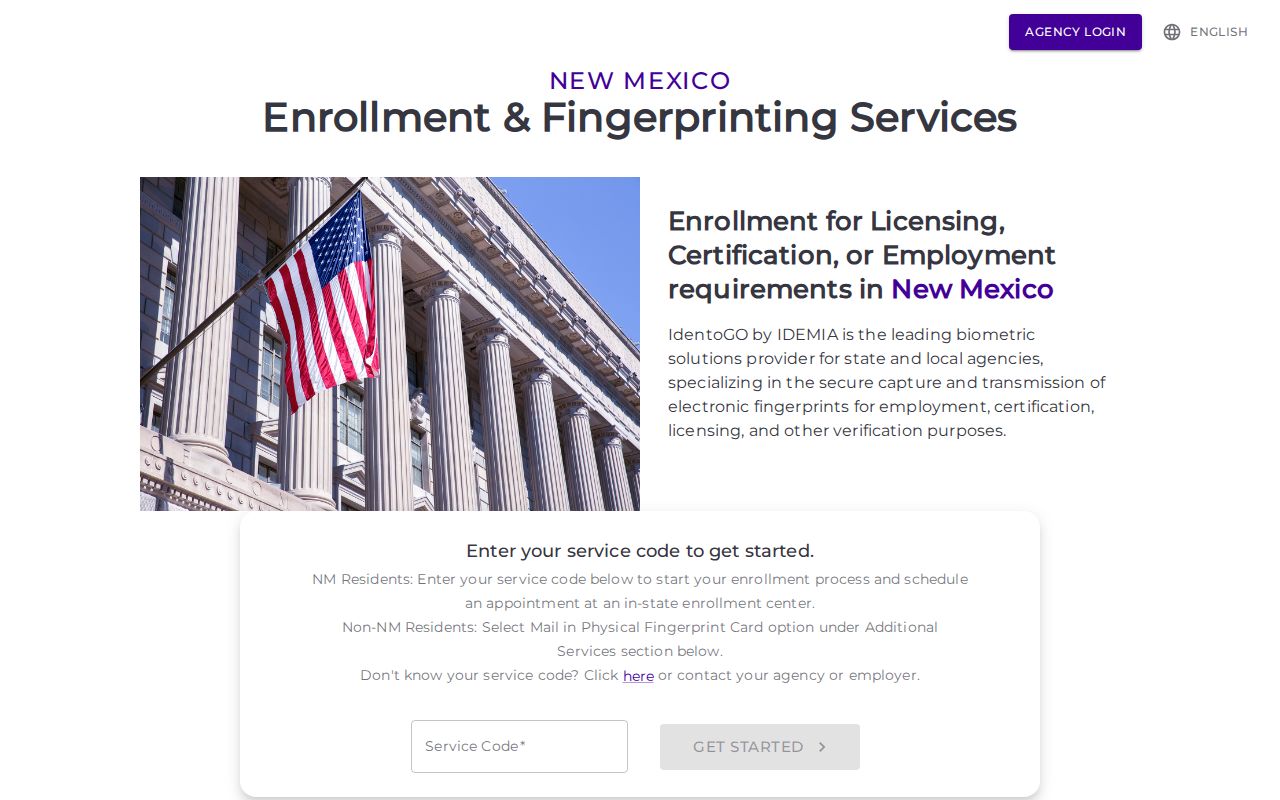
The enrollment screen also provides appointment management and a mail-in physical-card route for people outside New Mexico.
DPS states that an electronic state response normally reaches the requesting agency in 24 to 48 hours, while an FBI response normally takes 48 to 72 hours after submission. Program fees vary. Check accepted identification, payment, and appointment rules in the confirmation rather than relying on a copied storefront list.
Note: Manual fingerprint card service creates rolled cards only; the cards must still be submitted through the proper authorized check route.
New Mexico DPS Checks vs County Records
A DPS rap sheet compiles fingerprint-linked arrests from across New Mexico and attaches outcomes the repository has received. A county record preserves the source event. It can show a recent booking, complaint, motion, hearing, judgment, or dismissal before that fact reaches DPS. Neither source replaces the other.
| Point | New Mexico DPS check | County records |
|---|---|---|
| Coverage | Reported qualifying arrests statewide | Arrests, bookings, and cases in one county |
| Identity | Fingerprint-linked arrest cycles | Booking number, report number, name, or court case number |
| Detail | Summary arrest and received disposition lines | Original report, docket, pleadings, judgment, and booking events |
| Timing | Depends on contributor reporting and matching | Updates as the local event or case moves |
| Best use | Reviewing your statewide New Mexico repository history | Verifying the full facts and certified outcome of one event |
Use the county directory to locate the sheriff, detention layer, and court route for the originating county. Send an IPRA request to the public body that actually holds the requested record.
New Mexico DPS Clearinghouse
The Criminal History Clearinghouse shows the difference between a powerful criminal-justice tool and a public product. DPS reported that the Clearinghouse delivered 7,782 combined-source bail-history reports during 2025 to 16 courts and 18 judges. Those reports can combine arrests, warrants, court cases, probation or parole, and registry status for participating judicial work. They are not an open statewide search.
An official March 2026 DPS profile describes the program's reach.
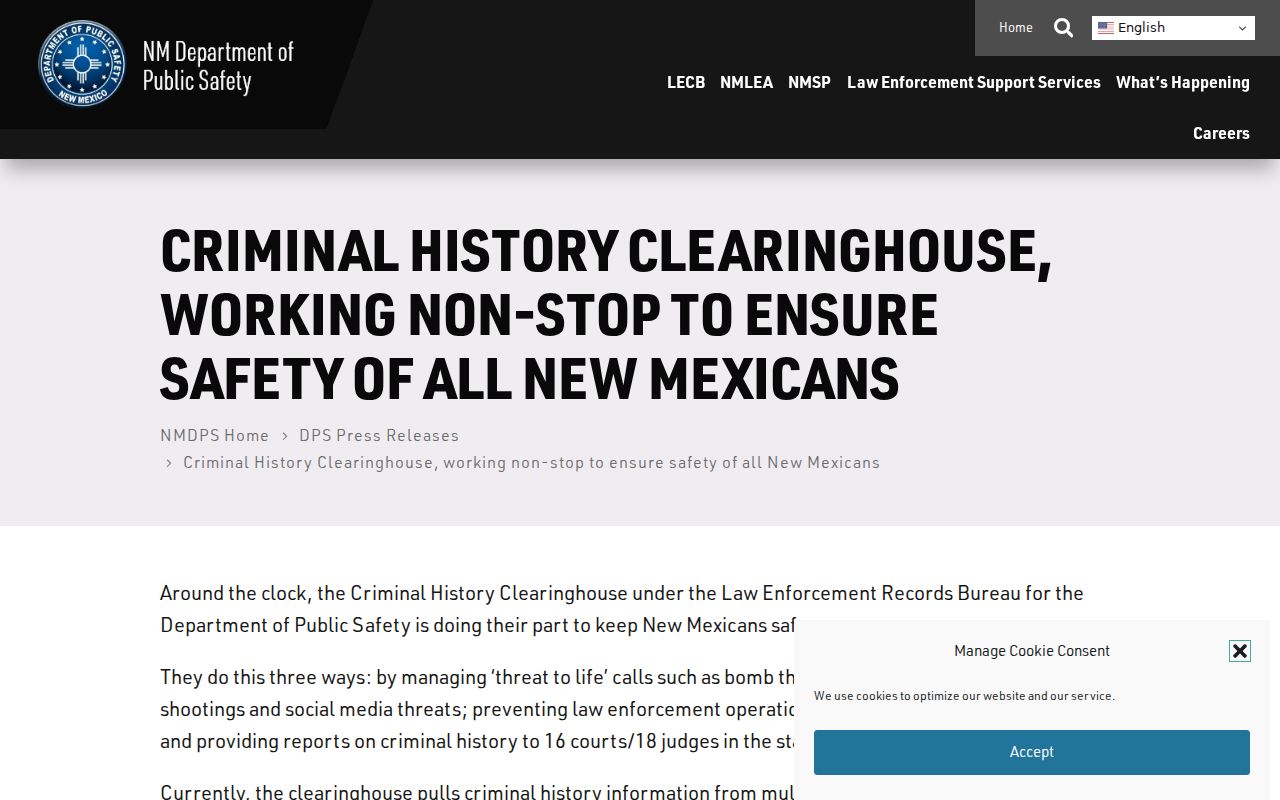
The Clearinghouse illustrates how access depends on purpose and authority even when DPS can technically connect several systems.
New Mexico DPS Expungement Unit
The New Mexico Criminal Record Expungement Act took effect in 2020. A district-court order may require work across linked arrest, warrant, supervision, incarceration, and public-access entries. LERB's Expungement Unit applies the order within state criminal-justice systems and notifies the FBI. It also investigates correction calls and coordinates changes when an error reaches federal data.
The January 2026 New Mexico DPS profile describes the unit and current system modernization.
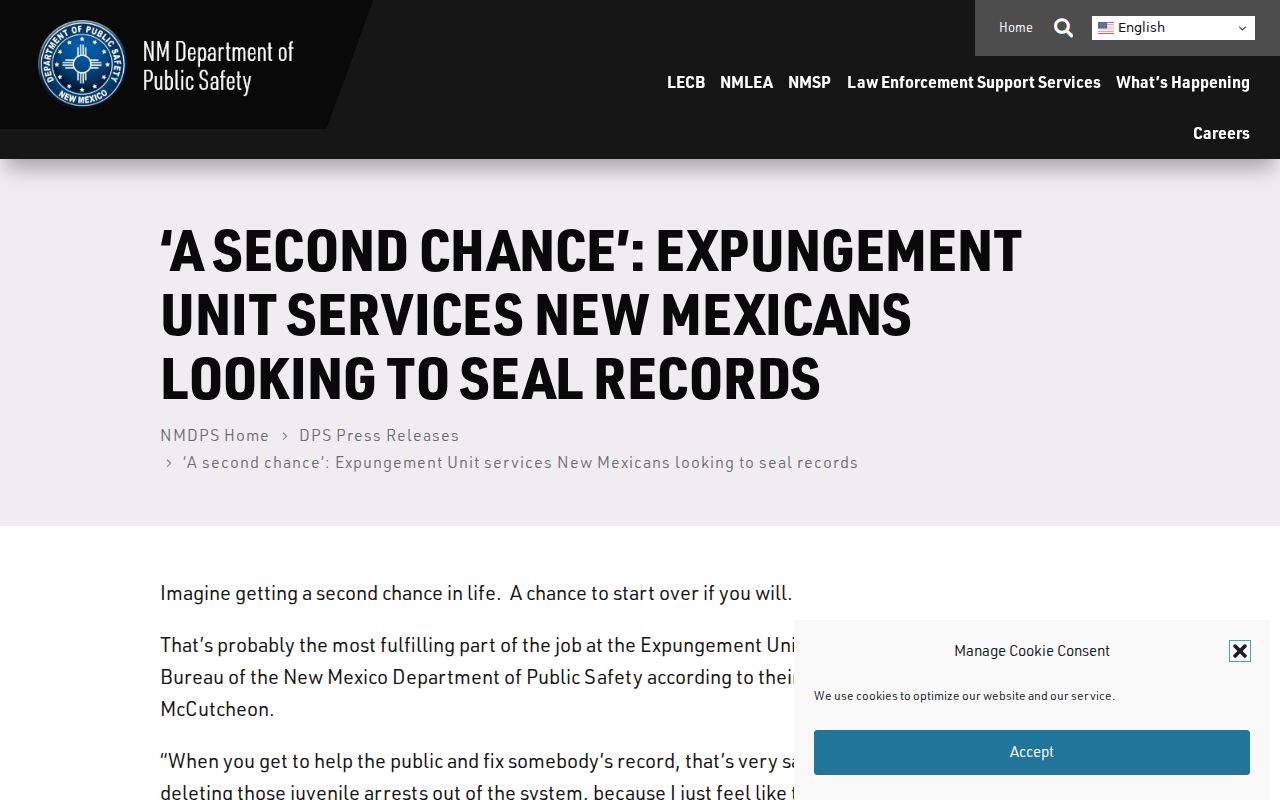
The profile reinforces a key check: after an order is processed, obtain a fresh DPS record and verify each public system rather than assuming one update changed every copy at once.
Correcting Errors in Your New Mexico DPS Record
Start with your authorized DPS record and identify the questioned arrest cycle by state tracking number, date, agency, and charge. Then compare it with the originating agency record, Case Lookup, and a certified judgment, dismissal, acquittal, declination, or expungement order. Section 29-3-12 assigns correction of inaccurate submitted facts to the supplying agency and requires notice to DPS.
- Order your own $15 New Mexico DPS record through the notarized authorization route.
- Match each fingerprint cycle to the correct county case and identify the missing or wrong fact.
- Obtain certified source proof and give LERB the questioned cycle and documentation.
- Order a fresh record after processing, then check the state, court, and FBI records that may have carried the old data.
If the FBI Identity History Summary is wrong, use the FBI or source-agency challenge as well. A corrected public court portal entry does not by itself prove that the New Mexico or FBI biometric record changed. Keep every submission and response so the correction path can be traced.