
Criminal Cases in the New Mexico Courts
New Mexico uses several court levels. District Court has general jurisdiction and is the main felony trial court. Magistrate courts hear state misdemeanors, DWI and traffic cases, warrants, initial appearances, and felony preliminary hearings. Metropolitan Court fills that limited-jurisdiction role in Bernalillo County. Municipal courts handle ordinance offenses and certain traffic, DWI, and petty misdemeanor matters within city limits. The Court of Appeals reviews most District Court criminal appeals. The New Mexico Supreme Court has mandatory jurisdiction when a life sentence was imposed and may review other criminal matters.
The New Mexico Judiciary reports 13 judicial districts, 34 district courts, 43 magistrate courts, one Metropolitan Court, and 78 municipal courts in its current overview. Judiciary clerks keep criminal case files. They are not the elected county clerks who record deeds and run elections. The Find Your Court directory identifies the right filing office. That court owns the official record even when New Mexico Case Lookup displays its docket data.
The Judiciary's municipal court overview shows where local ordinance cases fit in the New Mexico court system.
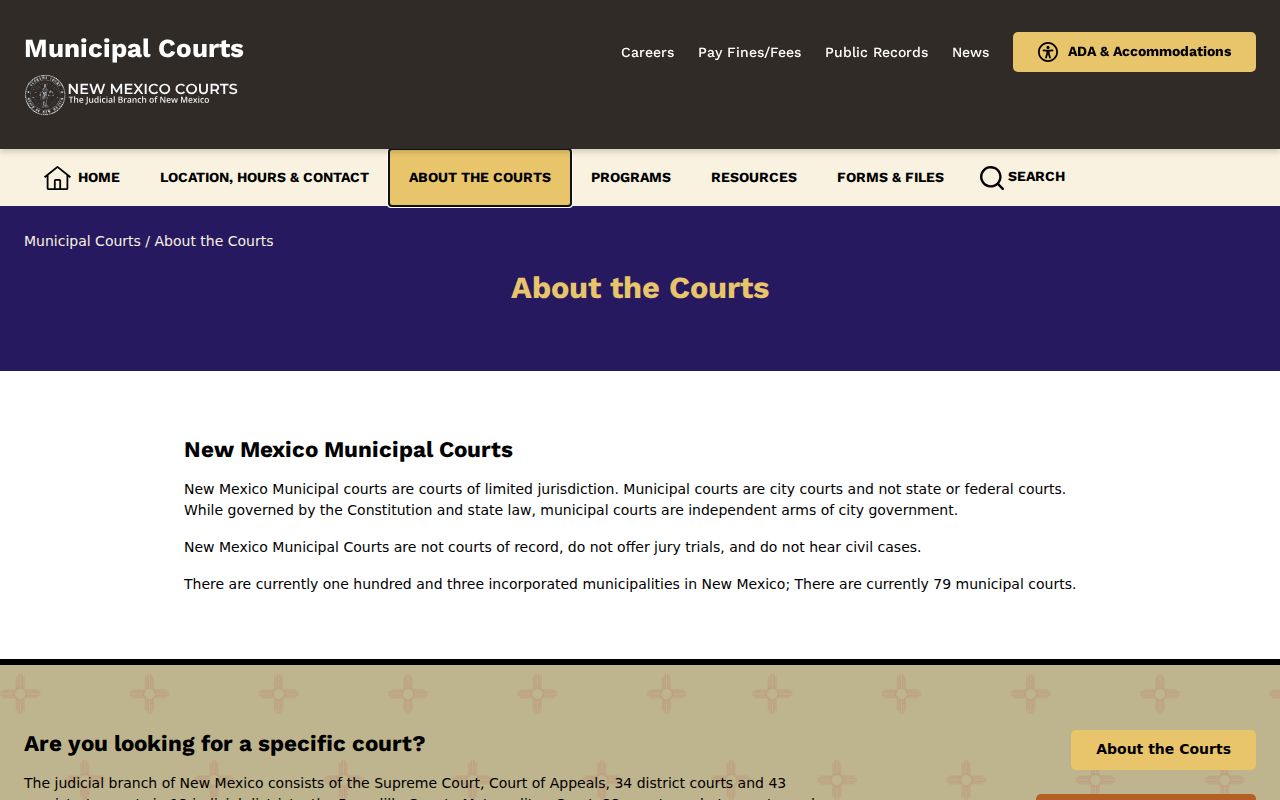
This court-level split explains why one New Mexico criminal case search may need both a statewide query and a direct municipal clerk request.
New Mexico Criminal Court Levels
The charge and procedural stage determine the proper New Mexico court. A felony can begin with an initial appearance or preliminary event in Magistrate or Metropolitan Court, then move to District Court after an information or grand-jury indictment. A misdemeanor usually stays in the limited court with jurisdiction. An ordinance matter may never enter broad statewide coverage. Appeals from magistrate and municipal courts generally go to District Court. District Court felony judgments ordinarily go to the Court of Appeals, except matters assigned to the Supreme Court.
| New Mexico court | Criminal work | Next review |
|---|---|---|
| Municipal Court | Ordinances and covered local traffic or petty matters | District Court |
| Magistrate or Metropolitan | Misdemeanors, warrants, initial appearances, felony preliminary stages | District Court |
| District Court | Felony trials, other general-jurisdiction cases, lower-court appeals | Court of Appeals or Supreme Court |
| Appellate courts | Review of the record and preserved legal issues | Supreme Court is final state court |
Note: A New Mexico court location in the statewide menu does not prove that all historic records from that location are online.
How to Search New Mexico Case Lookup
New Mexico Case Lookup is free, requires no registration, and provides public case summaries rather than document images. Search by a full case number when possible. A name search should follow the portal's last, first, middle format and use a date of birth, court, case category, or date range to narrow results. Match the court, filing date, and individual charges. A similar name alone is not enough to identify a person.
- Choose Name Search, Case Number Search, or the narrower DWI Search.
- Enter the full case number, or add identity details and a date range to a name query.
- Limit the query by court type, location, and criminal category when those facts are known.
- Open the result and read every charge, hearing, docket event, disposition, and warrant entry.
- Use re:SearchNM or the originating clerk for pleadings, orders, and certified copies.
| Field label | Type | Required | Use |
|---|---|---|---|
| Search mode | Tabs | Choose one | Name, full case number, or DWI search |
| Name and birth date | Text/date | No | Use together to reduce same-name results |
| Court type and location | Dropdowns | No | Limit by District, Magistrate, Metropolitan, or Municipal |
| Case category | Dropdown | No | Select criminal when available |
| Filing or hearing dates | Choice/range | No | Set the date type, then from and to values |
| Full case number | Segmented text | Case mode | Enter every known segment |
The official Case Lookup application displays the live New Mexico criminal court search controls.
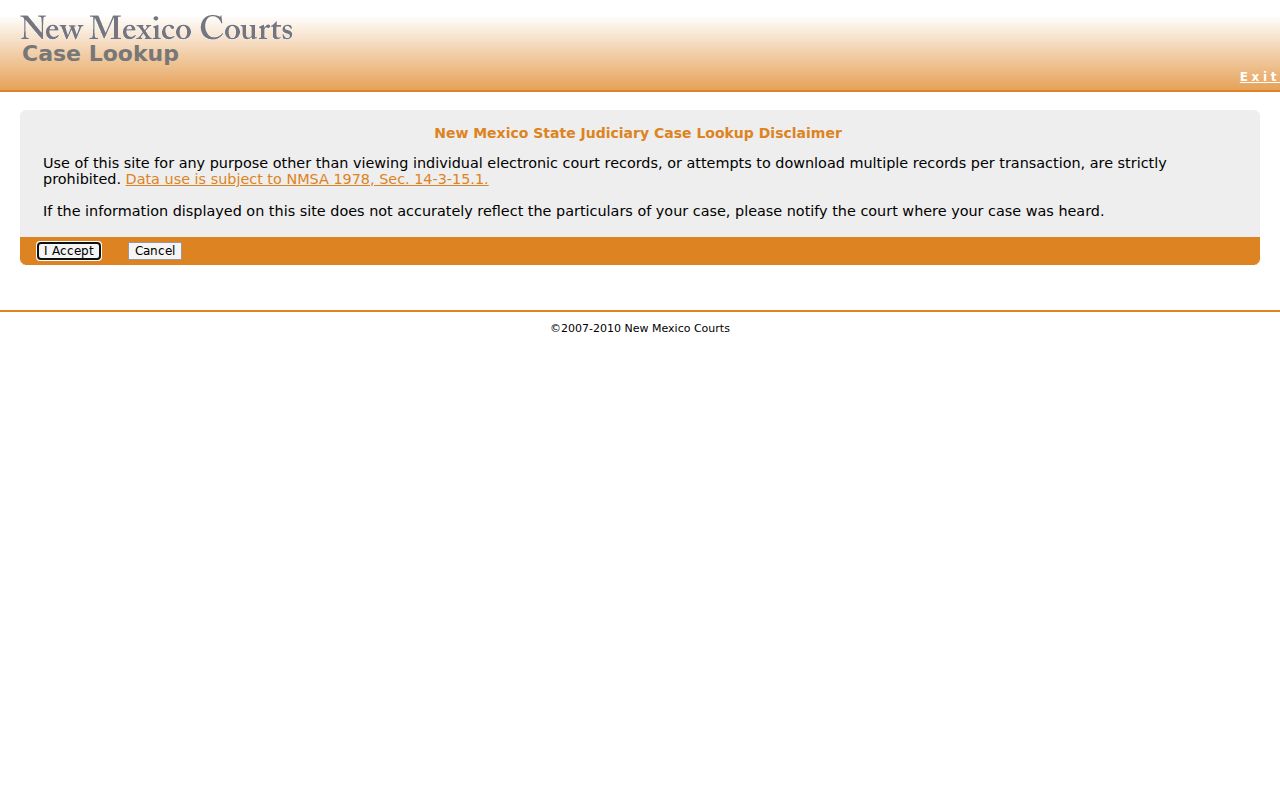
The interface helps separate name, case-number, court, and date searches before a reader evaluates the resulting docket.
New Mexico Case Lookup Limits
Case Lookup covers appellate, district, magistrate, and metropolitan summaries. Its municipal coverage is narrow: historic criminal domestic-violence and DWI convictions beginning September 1, 1991. District and magistrate entries are normally current within 24 hours of court entry, but coverage before statewide automation finished in June 1997 varies by court. The public system excludes sealed and confidential cases. Juvenile criminal cases have not displayed since July 1, 2007, and Family Violence Protection Act order cases have not displayed since July 1, 2008.
No public Case Lookup result includes filed documents, Social Security numbers, or addresses. A missing New Mexico court record may be old, municipal, newly filed, restricted, expunged, spelled under an alias, or held only by the clerk. Absence from the index does not prove no case exists. Bulk downloading is also barred. Older records route to the court archive or the Judiciary public-records gateway.
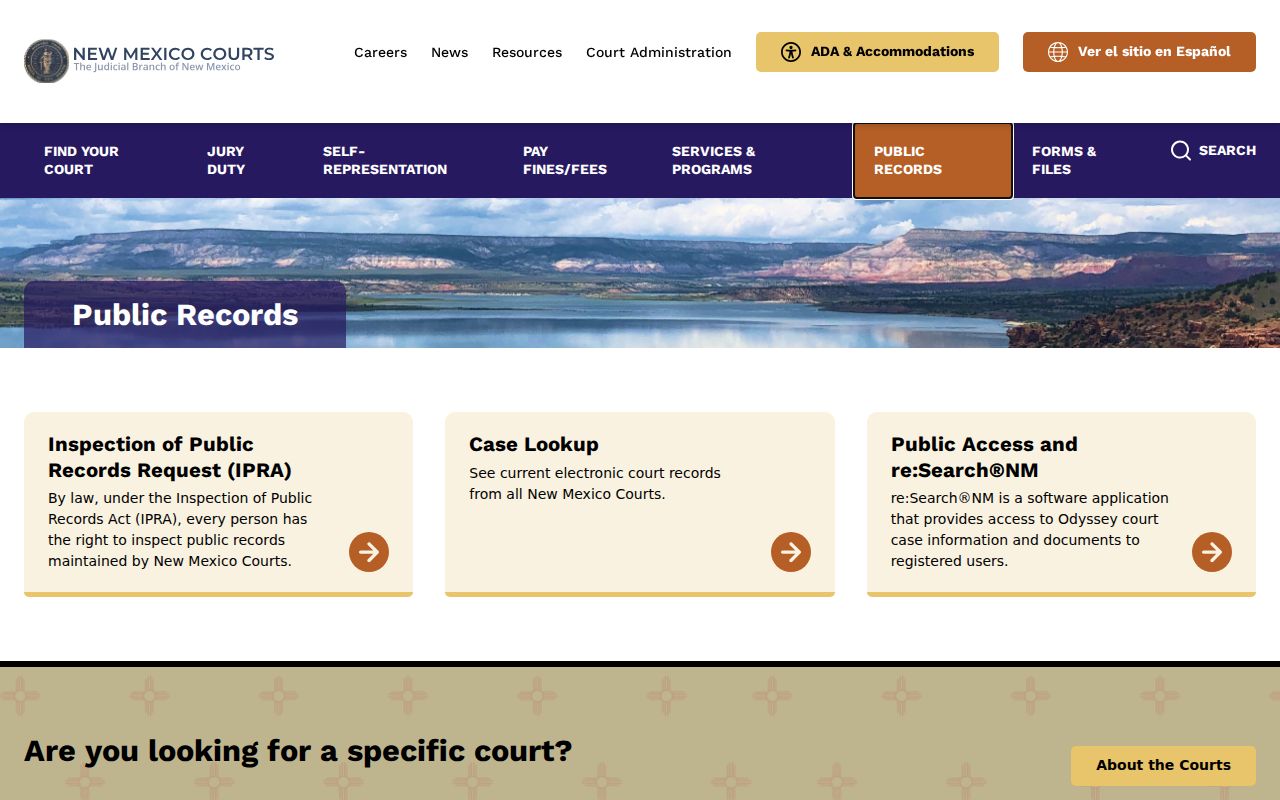
The gateway supplies the correct fallback when the statewide New Mexico criminal case index cannot answer a document or archive request.
What the Case File Shows
A New Mexico criminal case file is organized around a prosecution, not a person's whole arrest history. It may show the complaint, information, or indictment; each charge; motions; hearing notices; pleas; orders; judgment; sentence; warrant events; and the financial ledger. Case Lookup supplies part of that picture as metadata. re:SearchNM may provide permitted documents by access tier. The clerk remains the source for a certified judgment, sentence, dismissal, acquittal, or expungement order.
| Case Number & Court | Identifies the court level, location, category, filing year, and sequence where encoded. |
|---|---|
| Charging Documents | Shows the filed allegations, which may differ from the booking labels. |
| Docket Entries | Lists filed actions, motions, orders, warrants, and other public events in time order. |
| Hearing Dates | Shows scheduled or completed events and their types. |
| Disposition | Records the result for each count, such as conviction, dismissal, or acquittal. |
| Sentence & Judgment | States the court's final order, custody or supervision terms, and financial duties. |
Note: A closed New Mexico case is not automatically a conviction; the count-level disposition states what happened.
New Mexico Court Document Tiers
re:SearchNM requires registration and provides Odyssey case information and permitted documents according to the user's approved role. Tier 1 covers most public case types. Higher tiers can involve restricted material, applications, and nondisclosure terms. Registration does not make juvenile, abuse and neglect, adoption, mental-health, sealed, or other protected records public. The service replaced SOPA beginning April 7, 2023, though the Judiciary kept SOPA available during migration work.
The New Mexico Judiciary's public access and re:SearchNM explanation distinguishes the open summary index from registered document access.
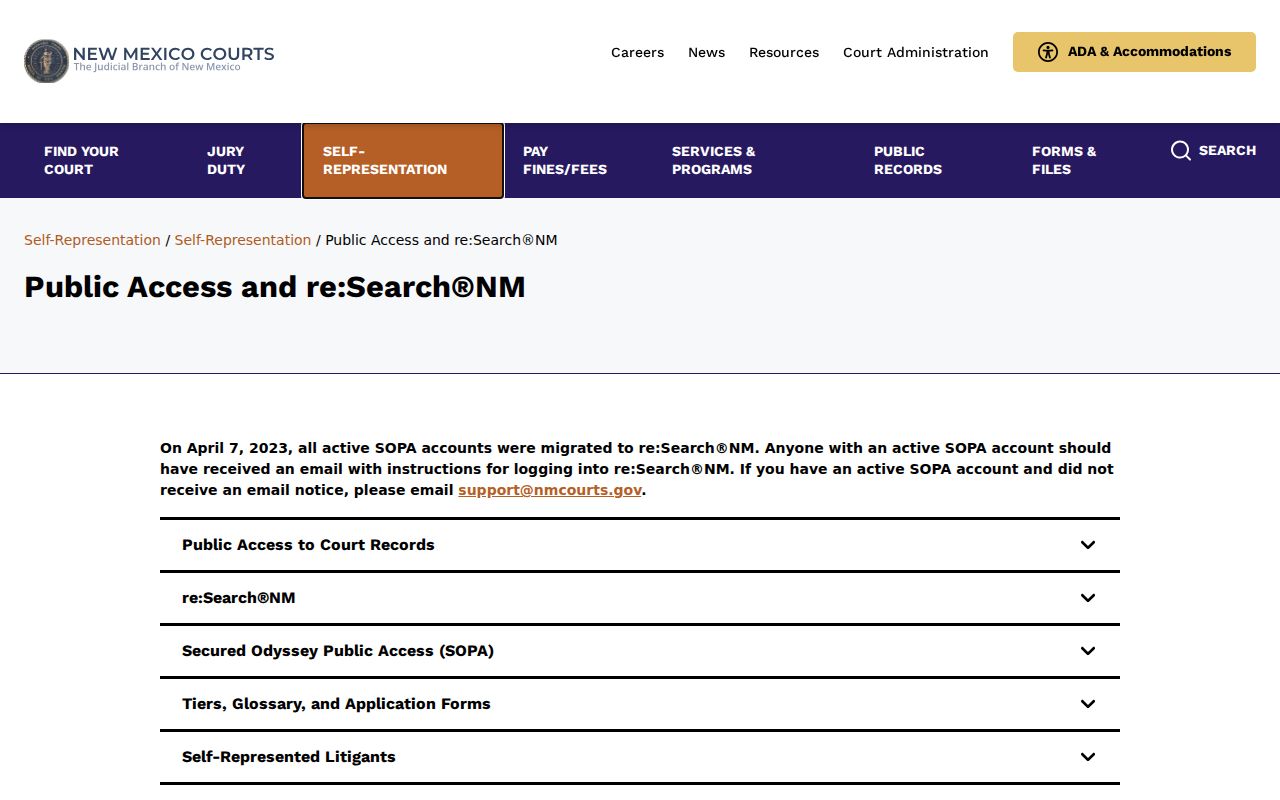
That tier model is why a Case Lookup hit can confirm a docket while the linked pleading still requires re:SearchNM access or a clerk request.
Stages of a New Mexico Criminal Case
A New Mexico criminal case changes as it moves. The first filed complaint records the initial accusation. An arraignment presents the filed charges and takes a plea. Felony preliminary steps may occur below District Court before an information or indictment starts the trial-level case. Pretrial motions can shape evidence and procedure. A plea or trial produces count-level results. A judgment states the legal outcome, and sentencing sets custody, supervision, fines, restitution, and other terms. An appeal creates a related record in the reviewing court.
Case flow: Charges Filed › Arraignment › Pretrial › Plea or Trial › Disposition › Sentencing
Read each count through the full flow. A booking charge may be amended, replaced, or dismissed after prosecutor screening. Pending means no final outcome has been entered. Disposed or closed means the matter reached an outcome, but it does not name that outcome. A warrant or failure-to-appear event must be confirmed with the issuing New Mexico court because the public docket may not show real-time enforcement status.
Reading New Mexico Criminal Case Numbers
A full New Mexico case number is a strong search key. The example D-202-CR-2021-00100 identifies District Court with the letter D, location code 202, the criminal category CR, the filing year, and a sequence number. M can identify Magistrate Court, while T identifies Metropolitan Court. Municipal and appellate formats can differ. Copy all separators and leading zeros when making a clerk request.
- Complaint
- A sworn allegation that commonly starts a limited-court case or felony preliminary process.
- Information
- A prosecutor-filed instrument used to advance a felony where law permits.
- Indictment
- A grand jury's formal accusation.
- Disposition
- The result for a charge or case, such as conviction, dismissal, or acquittal.
- Deferred sentence
- A sentence whose final consequence is delayed while conditions are completed; it is not automatic expungement.
These labels help connect separate New Mexico court records without confusing a preliminary file, a District Court prosecution, and an appeal.
New Mexico Case Files and Rap Sheets
The New Mexico court file and the New Mexico DPS rap sheet are related but distinct. The case file centers on one prosecution and can show judges, attorneys, hearings, pleadings, individual counts, orders, disposition, sentence, and money owed. The New Mexico DPS record is an identity-centered, fingerprint-linked chronology of qualifying arrest cycles and outcomes reported to the State Central Repository. It does not contain the full set of motions, evidence, or filed pleadings.
A dismissal may appear in the court docket before the outcome reaches the repository. A missing DPS disposition is a reporting gap, not proof that a New Mexico charge remains pending. For self-review, obtain the certified disposition from the clerk and use it with the DPS correction process. The New Mexico DPS criminal history process addresses the identity-centered record, while the court supplies the case-centered proof.
Finding Case Records by County
The complete New Mexico criminal case file remains with the clerk of the court where it was filed. Start with District Court for a felony prosecution. Check Magistrate or Metropolitan Court for misdemeanors and preliminary matters. Contact the municipal clerk for ordinance files that statewide coverage omits. Give the clerk a full case number, party name, filing range, and the exact document sought. Ask whether inspection, ordinary copies, certification, exemplification, or audio is needed.
The official Second Judicial District Court page illustrates how a New Mexico District Court presents local clerk and case access.
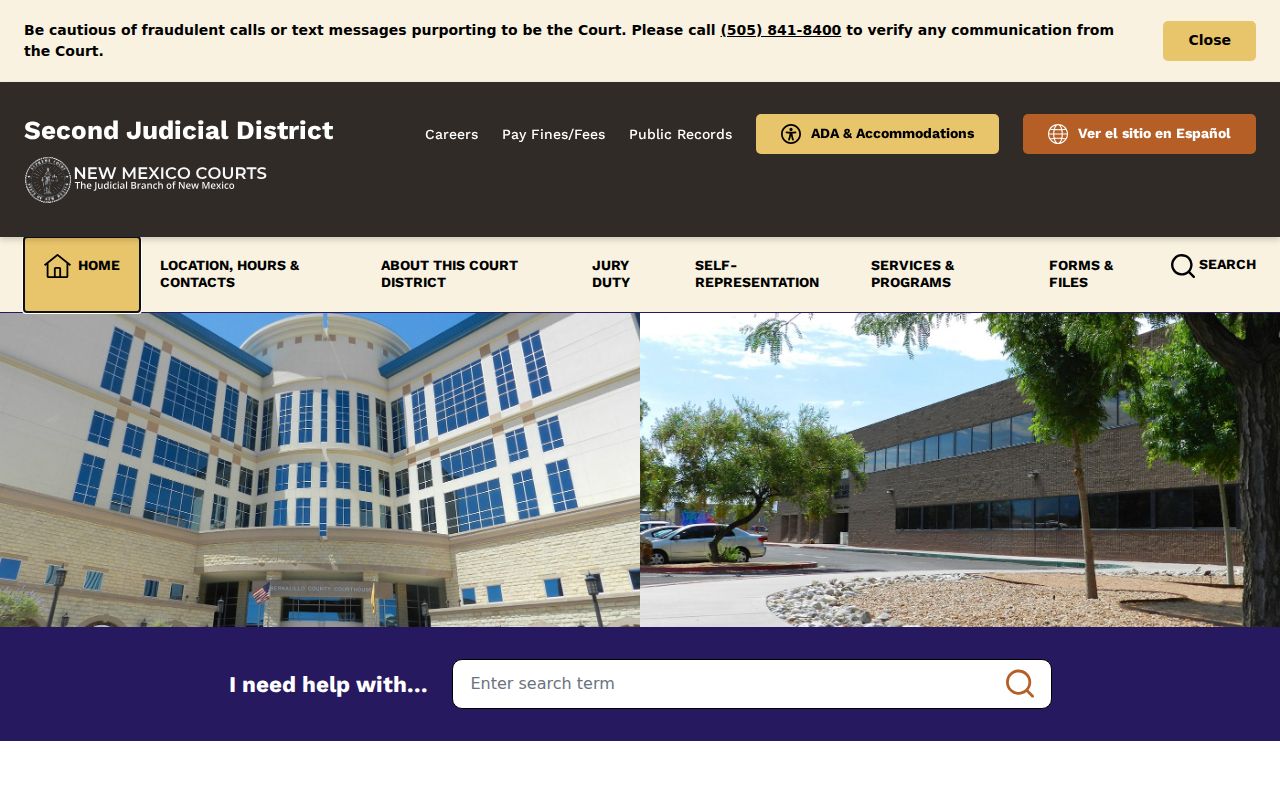
Its local route is one example, not a statewide records counter. Each filing court controls its own official file.
A court's case records request instructions also show the details needed for document-level access.
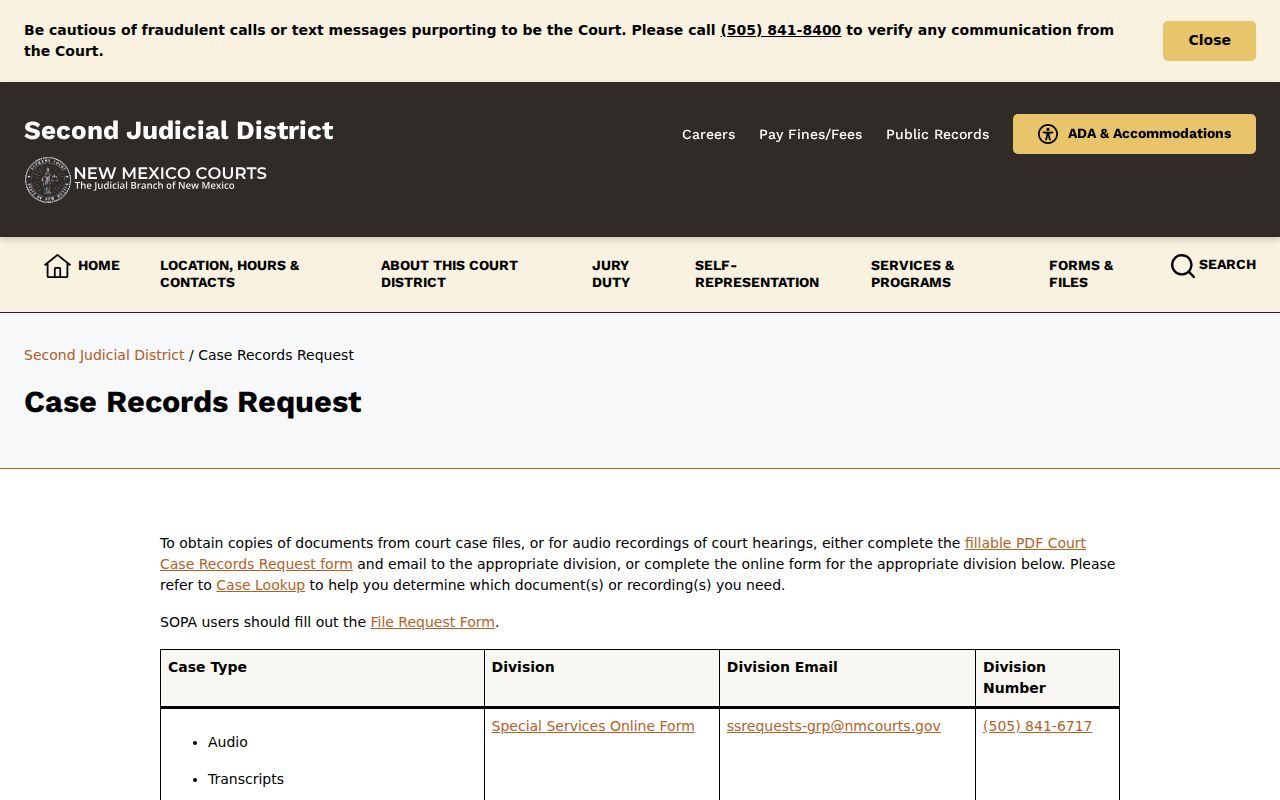
Use that pattern with the correct originating court. Browse the directory of all 33 New Mexico counties to reach the local criminal records route for any county.